
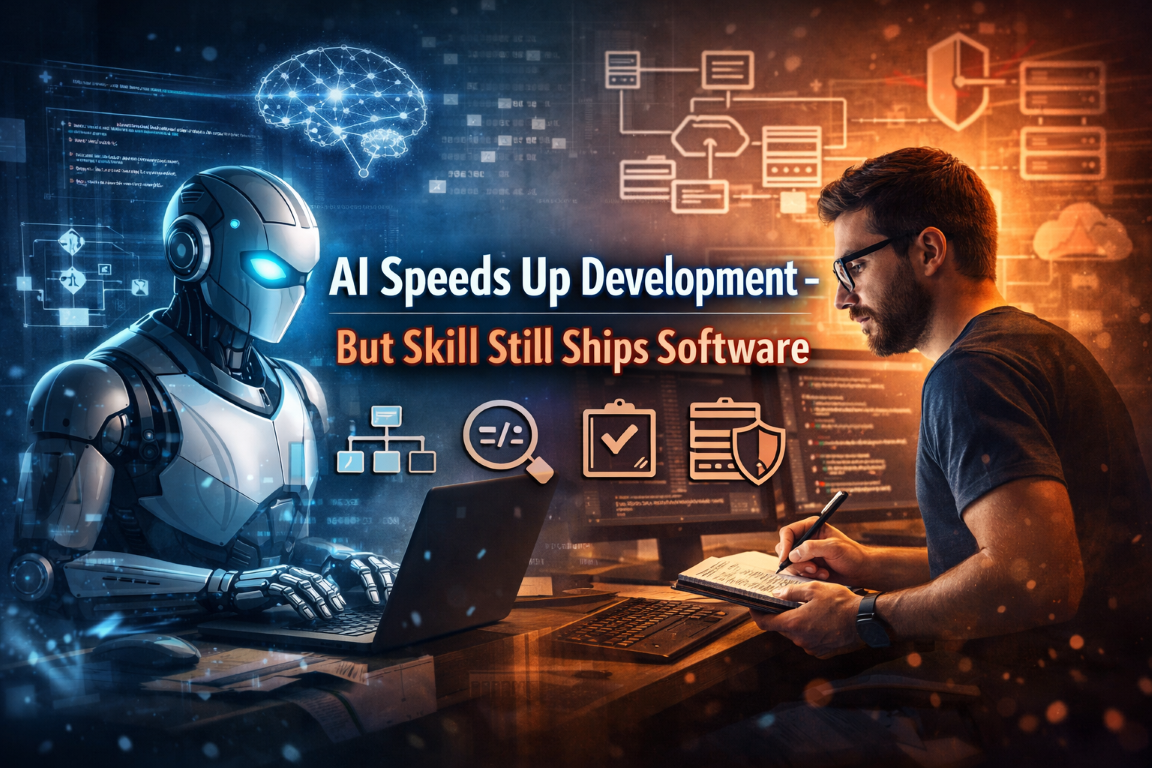
AI Speeds Up Software Development, But Skilled Engineers Still Ship Systems
Artificial intelligence has changed software development in a real and measurable way. Tasks that once took days, like generating boilerplate code, scaffolding features, or creating initial prototypes...
Artificial intelligence has changed software development in a real and measurable way. Tasks that once took days, like generating boilerplate code, scaffolding features, or creating initial prototypes, can now happen in minutes. Development velocity is higher. Iteration cycles are shorter. Teams can explore ideas faster than ever before.
At Machus, we use AI daily in our software development process. What we have learned is simple and important. AI accelerates development, but it does not replace the need for experienced human developers. In many ways, it actually makes strong engineering skills more important, not less.
Architecture Still Drives Successful Software Projects
AI can generate code quickly, but it does not design systems. Software architecture still requires human judgment, experience, and accountability.
Every project involves trade-offs between performance, scalability, security, cost, and long-term maintainability. Those decisions depend on understanding business goals, future growth, operational risk, and real-world usage patterns. AI can suggest patterns, but it cannot understand the full context of your organization or the consequences of technical debt years down the road.
Skilled software architects decide how systems are structured, how services communicate, where data lives, and how failures are handled. That responsibility remains firmly human.
Developers Must Understand the Code AI Produces
AI-generated code is not magic. It becomes part of your application, your infrastructure, and your ongoing maintenance burden.
Professional developers still need to read, understand, and reason about every line of code that enters a system. This includes refactoring AI-generated output to match project standards, identifying edge cases, correcting subtle logic errors, and ensuring consistency across the codebase.
Relying on AI without understanding the resulting code creates fragile systems. Speed without comprehension leads to bugs that surface later, often in production, where they are far more expensive to fix.
AI Requires Guidance, Context, and Correction
AI is only as effective as the developer guiding it. Prompt quality, constraints, and follow-up corrections all shape the outcome.
Experienced engineers know how to ask precise questions, define boundaries, and iterate intelligently when the initial output is incomplete or incorrect. They recognize when an AI solution is close but flawed, and when it is fundamentally wrong for the use case.
This is not hands-off development. It is an active collaboration where human expertise directs the tool at every step.
Testing and Quality Assurance Still Depend on Human Judgment
AI can help generate test cases, but it cannot decide what truly matters to test.
Humans define business-critical workflows, failure scenarios, and edge cases that reflect how real users behave. They interpret test results in context and validate whether a system behaves correctly under stress, not just whether automated tests pass.
Reliable software depends on thoughtful testing strategies, not just test coverage numbers. That insight still comes from experienced developers and QA professionals.
Deployment, Security, and Operations Are Still Human Responsibilities
Modern software development does not end with code. Deployment pipelines, infrastructure configuration, security hardening, monitoring, and rollback planning all require deep system understanding.
AI can assist with scripts and configurations, but it does not own production environments. Engineers do. When something breaks, when data is at risk, or when uptime matters, human accountability is essential.
AI Changes How Software Is Built, Not Who Is Responsible
AI has undeniably sped up software development. What it has not done is eliminate the need for skilled human engineers.
The most effective teams are not those replacing developers with AI. They are teams using AI as a force multiplier, paired with experienced professionals who architect systems, understand the code, guide AI output, test thoroughly, and deploy responsibly.
At Machus, we see AI as a powerful tool in modern software development. But tools do not ship software. People do.
Clients do not pay for code generation. They pay for systems that work, scale, and hold up over time. That still requires human skill, judgment, and ownership.
wordpress
Custom Themes and Plugins
Tailored WordPress solutions to fit your business—whether it's a unique theme or a custom plugin, we've got you covered.
Service spotlight
Development
Custom web, software, API, and mobile development tailored to your business needs with modern frameworks and a collaborative process.